
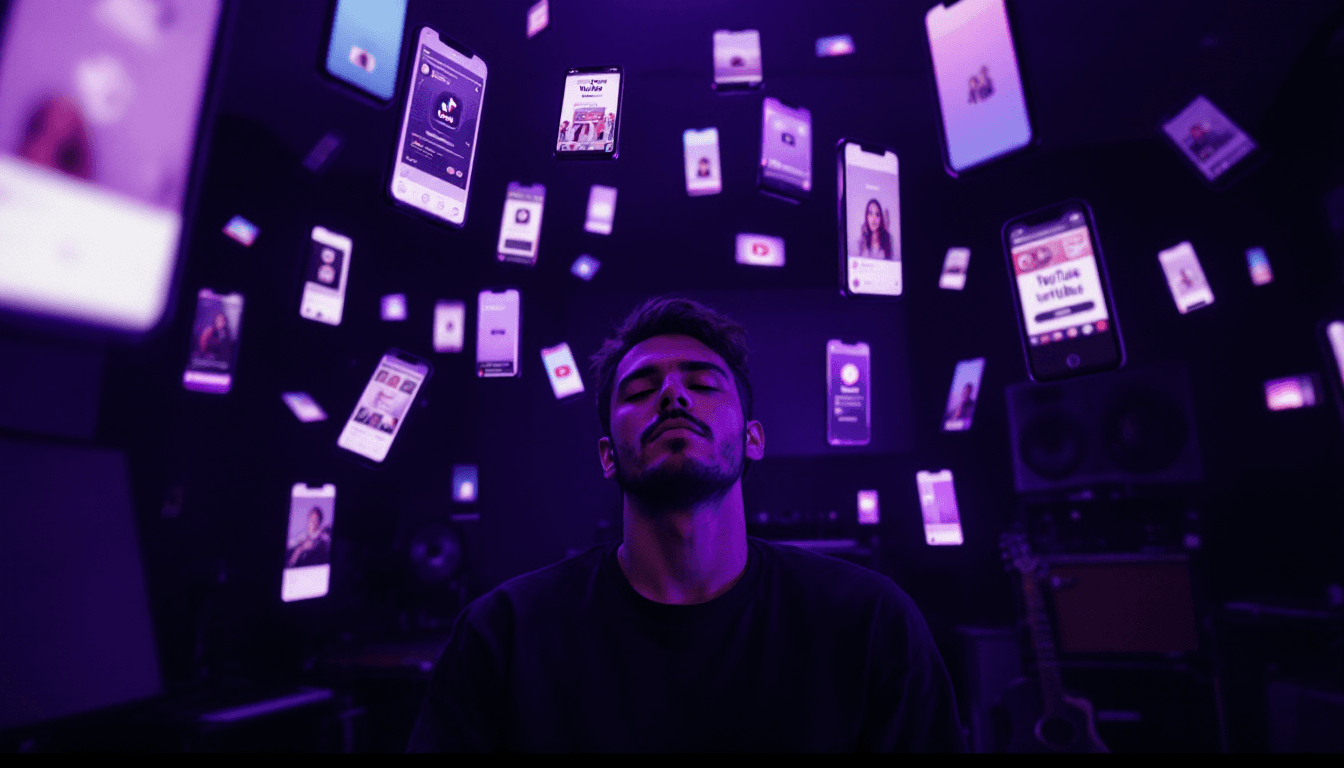
Here is your job description as an independent musician in 2026:
Write songs. Record songs. Mix songs. Master songs (or supervise mastering). Design album artwork. Write social media captions. Film vertical videos. Edit vertical videos. Post vertical videos. Respond to comments. Engage with other creators. Manage your email list. Update your website. Design merch. Pitch to playlists. Pitch to blogs. Pitch to sync libraries. Plan content calendars. Analyze streaming data. Run (or learn to run) ads. Book shows. Promote shows. Network. Collaborate. Repeat. Every day. Forever.
Oh, and somewhere in there, make art that's honest and meaningful. Good luck.
If reading that list made your chest tighten, you're experiencing what thousands of independent musicians describe as the content treadmill — the relentless expectation that being a working musician now means being a full-time content creator who also happens to make music.
The Numbers Behind the Exhaustion
According to Patreon's State of Create report, more than 60% of creators say algorithms shape what they make, and over half report burnout affecting their motivation to create. For musicians specifically, the pressure is compounded: you're not just creating content about a product. You ARE the product. Every video, every post, every caption is an extension of your artistic identity.
The Record Union survey of nearly 1,500 independent musicians found that 73% had experienced negative mental health symptoms connected to their music careers. Among 18-25 year olds, that number rises to 80%.
These aren't separate problems. The mental health crisis in independent music and the content treadmill are deeply connected. When your art becomes a content strategy, the joy gets squeezed out in ways that are hard to articulate but easy to feel.
Why "Just Batch Your Content" Doesn't Fix It
Every music marketing course will tell you to batch your content. Film five videos on Sunday. Schedule posts for the week. Use templates. Be efficient.
This is decent logistical advice wrapped in a fundamental misunderstanding of the problem. The issue isn't time management. It's that the work of content creation is a different kind of work than making music, and doing both at a professional level requires skills, energy, and mental bandwidth that are in direct competition with each other.
Writing a song requires vulnerability, introspection, and a willingness to sit with uncertainty. Editing a TikTok requires trend awareness, technical skill, and optimization thinking. These are not complementary mindsets. They're opposing forces.
The musician who spends their morning trying to write something honest and their afternoon trying to package it for an algorithm is doing two full-time jobs with different cognitive requirements. Batching doesn't change that. It just makes you more efficient at being exhausted.
The Comparison Trap Amplifier
Social media doesn't just demand your content — it shows you everyone else's. Every time you open Instagram to post, you see another artist who seems to be doing it better. Better videos. Better engagement. Better aesthetic. More followers.
What you don't see: their team of three. Their trust fund. Their eight failed videos before the one that worked. The panic attack they had before posting. The 14-hour day that produced that "effortless" 30-second clip.
Comparison was always a part of being an artist. But the content treadmill puts it on a loop, every single day, measured in real-time metrics that feel like a daily report card on your worth.
What Actually Helps
There is no magic solution that makes the content demands of modern music go away. But there are approaches that make the weight more bearable.
1. Choose one platform and go deep. You don't need to be on TikTok AND Instagram AND YouTube AND Twitter. Pick the one where your audience actually is (or the one you genuinely enjoy), and give yourself permission to be mediocre or absent on the others. One platform done well beats four platforms done half-heartedly.
2. Make content a byproduct, not a product. Film your actual creative process. Record the studio session. Capture the songwriting moment. The most sustainable content isn't manufactured — it's documented. This doesn't require a separate "content creation" workflow. It requires a camera on a tripod while you do what you already do.
3. Set hard boundaries on content time. Decide in advance: "I spend two hours on Monday and one hour on Thursday on content. That's it." Whatever gets done in that window is enough. The algorithm is insatiable. You don't have to be.
4. Let some things be bad. Not every post needs to be polished. Not every video needs a hook in the first second. Your audience follows you for your music and your personality, not your production quality. Give yourself permission to post the quick, unpolished, real stuff. It often performs better anyway.
5. Audit your tool stack. If you're logging into six different platforms to manage your career, that's six different cognitive loads, six different dashboards, six different things demanding attention. Consolidating your tools — analytics, scheduling, fan engagement, career planning — into fewer places reduces the mental overhead significantly.
The Permission You Might Need
You are allowed to be a musician who makes music.
That might sound obvious, but in the current climate, it's almost radical. The culture of independent music has so thoroughly absorbed the content-creator model that taking a week off social media feels like career suicide.
It isn't. Your fans will still be there. Your streams won't evaporate. The algorithm will not permanently punish you. These are fears manufactured by platforms that profit from your constant engagement.
Make your music. Share it in ways that feel sustainable. Build real connections with real people. The rest is noise.
Platforms like Musuni exist specifically to reduce the tool juggling — putting your analytics, content planning, fan engagement, and career tools in one place so you spend less time managing platforms and more time making music.
Key Takeaway
The content treadmill is not a time management problem. It's a structural problem where independent musicians are expected to perform multiple full-time jobs simultaneously. The solution isn't optimization — it's intentional reduction. Choose fewer platforms, make content from documentation rather than production, set hard time boundaries, and consolidate your tools.