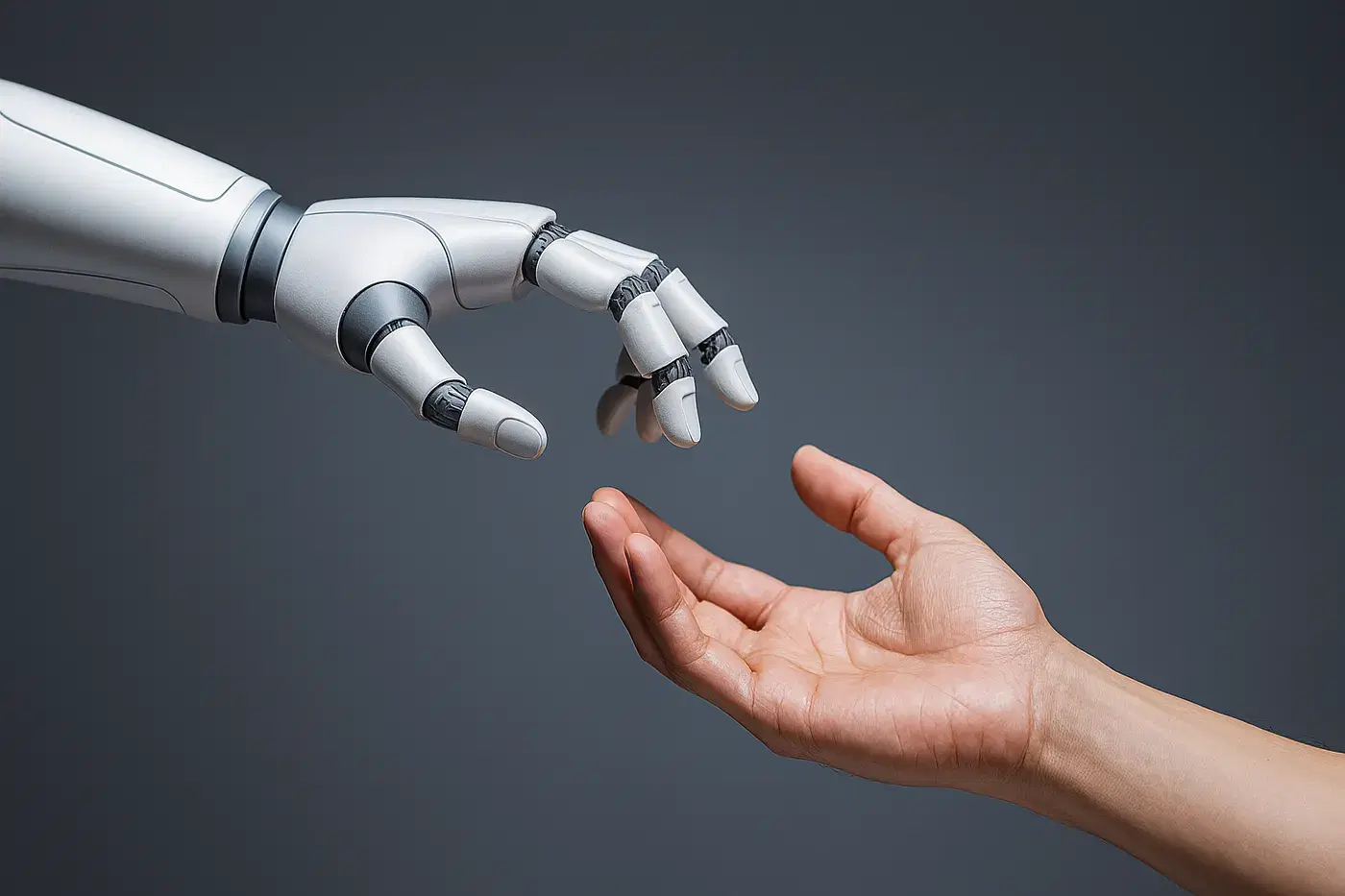
In the ever-evolving landscape of music creation, a new creative partnership has emerged — one between human artists and artificial intelligence. As we navigate through 2025, the relationship between musicians and AI has transformed dramatically from the initial fears of replacement to something far more nuanced and symbiotic. Today’s forward-thinking artists aren’t running from AI; they’re running with it, discovering that these tools can serve as powerful creative collaborators rather than competitors.
Beyond the AI Replacement Narrative
When AI music generation first gained mainstream attention, headlines often painted a dystopian picture: “Will AI Replace Musicians?” or “The End of Human Creativity?” These fear-based narratives missed a crucial understanding of how creativity actually works and how technology historically integrates into artistic processes.
The reality unfolding in 2025 is far more interesting. Rather than replacement, we’re witnessing augmentation — AI serving not as a substitute for human creativity but as an extension of it. Much like how the synthesizer didn’t replace musicians but instead expanded their sonic palette, AI tools are becoming instruments of inspiration and collaboration in the creative process.
How Artists Are Actually Using AI in Their Creative Process
Today’s artists are incorporating AI into their workflows in ways that enhance rather than diminish their unique creative voices. Here are some of the most impactful approaches:
1. Overcoming Creative Blocks
Every songwriter has experienced the frustration of staring at a blank page or DAW session. AI co-writers are proving remarkably effective at breaking through these creative impasses.
“I was stuck on this bridge section for weeks,” shares indie artist Maya Chen. “I fed the verses and chorus into my AI writing assistant and asked for bridge suggestions. Most weren’t right for the song, but one had this unexpected chord progression that completely shifted my perspective. I ended up writing something entirely different than both my original attempts and the AI suggestion, but I never would have gotten there without that spark.”
This example highlights a key insight: AI suggestions often serve not as final products but as creative catalysts, pushing artists to explore directions they might not have considered otherwise.
2. Expanding Musical Vocabulary
Many artists find themselves returning to familiar patterns, progressions, and lyrical themes — their comfort zone. AI tools can help break these habits by introducing unfamiliar elements.
Jazz pianist and producer Terrell Washington describes his experience: “I realized I was using the same voicings in most of my compositions. I started using an AI harmony tool to suggest alternative chord structures. Some suggestions were completely inappropriate for my style, but others introduced me to voicings I’d never considered. It’s like having a session with a pianist from a completely different background.”
3. Rapid Prototyping and Experimentation
The ability to quickly generate and test musical ideas has transformed how many artists approach the early stages of creation.
“Before, if I wanted to hear how a string arrangement might sound against my track, I’d have to either program it all myself or wait until much later in the process when I could afford to hire string players,” explains producer Sophia Reyes. “Now I can generate a decent mock-up in minutes, decide if that direction is worth pursuing, and then either refine it myself or bring in human players with a much clearer vision of what I want.”
This rapid prototyping capability allows artists to explore more possibilities before committing to a direction, often resulting in more adventurous and refined final products.
4. Translation Between Mediums
One of the most innovative applications involves using AI to bridge different creative languages.
“I’m not traditionally trained in music theory,” says electronic artist Dev Patel. “I can hear complex arrangements in my head but struggle to communicate them. I’ve started using an AI tool where I can hum melodies, describe the feeling I want, or even reference visual art that captures the mood. The AI generates musical sketches based on these inputs that I can then refine and develop.”
This translation capability is democratizing music creation, allowing artists to express their ideas regardless of their technical background or training.
The Ethical Framework for AI Collaboration
As these collaborations become more common, a set of ethical best practices is emerging within the artist community:
Transparency with Audiences
Leading artists are being upfront about their use of AI tools, helping normalize these collaborations while maintaining authenticity with fans. Rather than hiding AI involvement, they’re explaining how these tools fit into their creative process.
Folk-rock artist Liam Torres includes notes in his album credits: “Initial chord progression suggestions on tracks 3 and 7 were developed using AI assistance. All final compositions, arrangements, and performances are human-created.”
Attribution and Training Considerations
Ethical artists are increasingly concerned about the datasets their AI tools were trained on. Many are choosing tools that compensate original creators whose work informed the AI’s capabilities or that were trained exclusively on public domain works or licensed content.
Maintaining Human Direction and Final Decision-Making
The most successful AI collaborations maintain clear human direction and curation. The artist remains the creative director, with AI serving as a tool under human guidance rather than an autonomous creator.
The New Creative Workflow
A typical AI-assisted creative workflow in 2025 might look something like this:
1. Inspiration and Direction: The artist establishes the creative direction, emotional tone, and initial ideas.
2. Collaborative Exploration: AI tools generate variations, alternatives, or complementary elements based on the artist’s input.
3. Human Curation and Refinement: The artist selects, modifies, and refines the most promising elements, often departing significantly from the AI suggestions.
4. Technical Enhancement: AI assists with technical aspects like mixing suggestions, mastering references, or identifying potential issues in the composition.
5. Human Finalization: The artist makes all final decisions, adding the human touch, imperfections, and emotional nuance that define their unique voice.
This workflow preserves the artist’s creative agency while leveraging AI’s computational power and pattern recognition capabilities.
The Skills That Matter in the Age of AI Collaboration
As AI tools become more integrated into the creative process, certain skills are becoming increasingly valuable for artists:
Curation and Taste
The ability to recognize what works and what doesn’t — to select the right elements from a sea of possibilities — is becoming as important as the ability to generate ideas from scratch.
Conceptual Thinking
Artists who can think conceptually about their work — understanding the “why” behind their creative choices rather than just the “how” — are better positioned to direct AI tools effectively.
Prompt Engineering
Knowing how to communicate with AI systems — how to frame requests to get useful results — is emerging as a vital skill. Artists who can “speak AI” get better collaborative results.
Emotional Intelligence and Human Connection
The uniquely human ability to connect emotionally with listeners, to express vulnerability, and to tap into shared human experiences remains irreplaceable and is becoming a key differentiator.
Looking Forward: The Co-Creative Future
As we look toward the latter half of the decade, the relationship between artists and AI is likely to evolve further. We’re seeing early signs of more sophisticated collaborative models where AI systems can maintain longer creative “conversations” with artists, remembering previous interactions and developing a better understanding of the artist’s unique voice and preferences.
The most exciting possibilities lie not in AI creating finished works independently, but in these tools becoming increasingly personalized extensions of each artist’s creative process — tools that understand and complement their specific strengths, help shore up their weaknesses, and push them to grow in directions aligned with their artistic vision.
Conclusion: Embracing the Creative Partnership
The narrative around AI in music is shifting from replacement to partnership, from fear to possibility. The artists thriving in 2025 are those who have embraced this new creative relationship — not surrendering their artistic identity to algorithms, but strategically incorporating these powerful tools into their process while maintaining their unique human perspective and emotional core.
As AI continues to evolve, the question for artists is no longer whether to engage with these tools, but how to engage with them in ways that enhance rather than diminish their creative voice. The most successful artists will be those who view AI not as a competitor or a crutch, but as a collaborator — one with different strengths and limitations than human collaborators, but valuable nonetheless.
See Musuni in Action!
Want to experience how Musuni’s AI features can enhance your creative process without replacing your unique artistic voice? Our platform is designed to be your creative co-pilot, not your replacement. Watch our comprehensive platform demo to see how our AI tools can help you overcome creative blocks, expand your musical vocabulary, and streamline your workflow while keeping you firmly in the creative driver’s seat: https://www.youtube.com/watch?v=Bwp6ygwEN7M
Ready to explore the future of creative collaboration? Join the Musuni waitlist today at musuni.io and be among the first to experience a new kind of creative partnership.