
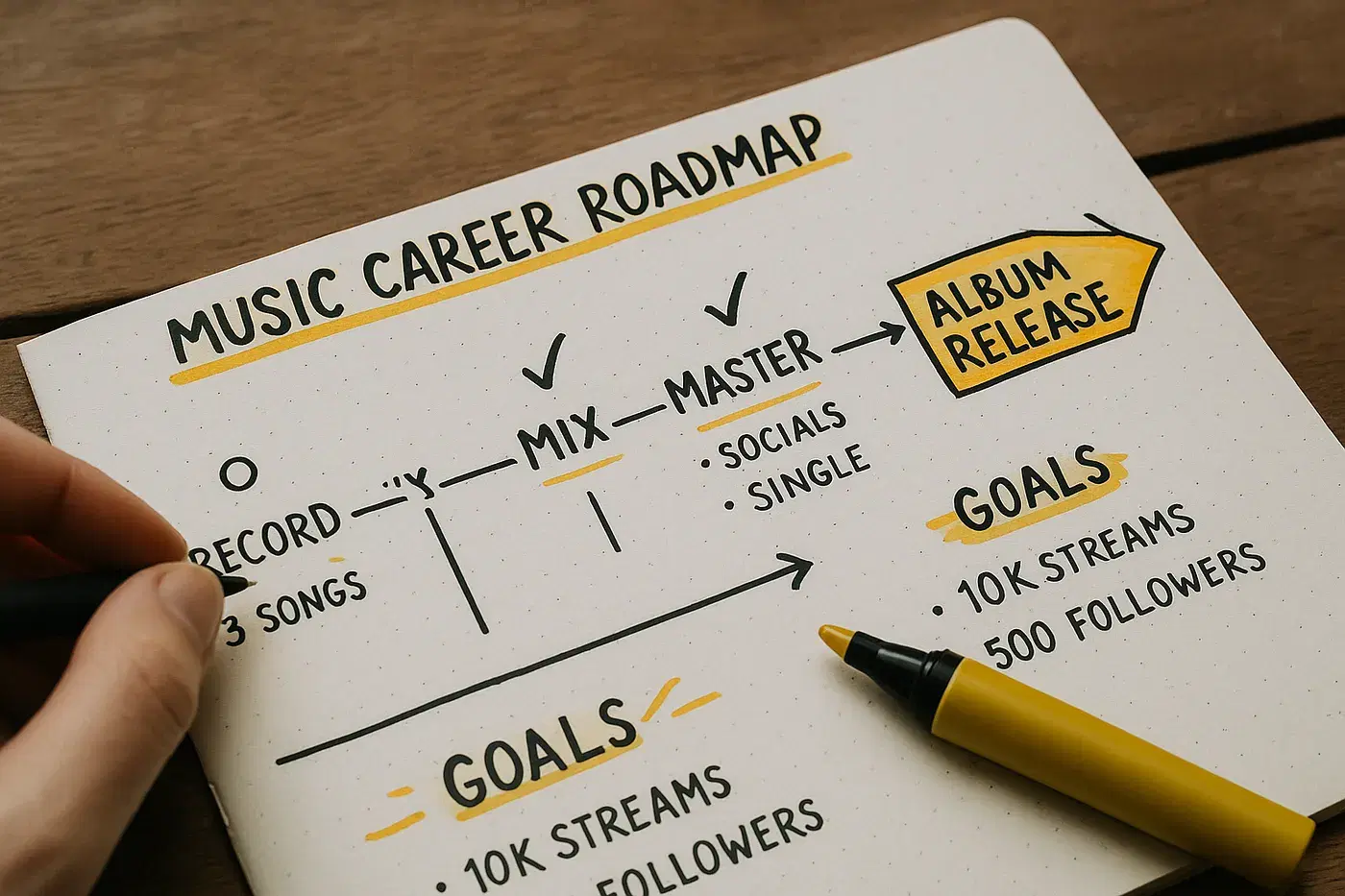
Building a successful music career rarely happens by accident. It requires not only talent and hard work but also clear direction and a way to measure progress. Just like using a map for a road trip, having a roadmap for your music career — complete with specific goals and milestones — helps you stay focused, make strategic decisions, and navigate the inevitable twists and turns. And in the digital age, data is the compass that keeps you on track.
Setting vague aspirations like “getting more popular” or “making it big” isn’t enough. To create a functional roadmap, you need to define clear, measurable goals and then use the data available to you to track your progress towards them. This transforms abstract dreams into an actionable plan.
Why Set Goals for Your Music Career?
Provides Focus:
Clear goals help you prioritize your time, energy, and resources on activities that directly contribute to your desired outcomes.
Motivates Action:
Having specific targets to aim for provides motivation and a sense of accomplishment as you reach milestones.
Enables Measurement:
Measurable goals allow you to track your progress objectively and understand what strategies are working (or not working).
Guides Decision-Making:
When faced with choices (e.g., which gig to take, where to invest your budget), your goals provide a framework for making the best decision for your long-term vision.
Defining SMART Goals for Musicians
A useful framework for setting effective goals is the SMART criteria:
Specific:
What exactly do you want to achieve? (e.g., Instead of “grow my fanbase,” try “increase my monthly Spotify listeners.”)
Measurable:
How will you track progress and know when you’ve achieved the goal? (e.g., “Increase monthly Spotify listeners *by 20%*.”)
Achievable:
Is the goal realistic given your current resources and situation? (e.g., Aiming for 1 million streams next month might be unrealistic if you currently have 100.) Set challenging but attainable targets.
Relevant:
Does the goal align with your overall artistic vision and career aspirations? (e.g., If your focus is sync licensing, a goal centered purely on TikTok followers might be less relevant.)
Time-bound:
When do you want to achieve this goal? (e.g., “Increase monthly Spotify listeners by 20% *within the next 6 months*.”)
Examples of SMART Goals for Musicians:
- Increase average monthly Spotify listeners by 25% in the next quarter.
- Gain 500 new, engaged Instagram followers within 3 months.
- Secure 3 playlist placements (editorial or major independent) for the next single release.
- Sell $500 worth of merchandise during the next tour.
- Complete and release a 5-song EP by the end of the year.
- Secure one sync placement in an independent film or web series within 12 months.
Using Data to Track Progress & Adjust Your Roadmap
Setting goals is only the first step. The real power comes from consistently tracking your progress using data and adjusting your strategy accordingly.
Identify Key Performance Indicators (KPIs):
For each goal, determine the specific metrics you need to track. Examples:
Goal: Increase Spotify listeners -> KPIs: Monthly listeners, streams per listener, follower growth, playlist adds.
Goal: Grow Instagram engagement -> KPIs: Follower growth rate, post reach, engagement rate (likes/comments/shares/saves per post), Story views/interactions.
Goal: Drive email sign-ups -> KPIs: Website traffic, sign-up form conversion rate, email list growth.
Establish Baselines:
Know where you’re starting from. Record your current KPIs before implementing new strategies.
Regularly Monitor Your Analytics:
Set aside time each week or month to check your dashboards (Spotify for Artists, social media insights, website analytics, email marketing reports). Don’t just glance at numbers; look for trends, patterns, and correlations.
Connect Activities to Outcomes:
Try to link specific actions (e.g., running an ad campaign, releasing a new video, pitching to playlists) to changes in your KPIs. Did that TikTok video lead to a spike in Spotify streams? Did the email campaign drive merch sales?
Analyze and Adapt:
Based on the data, what’s working? What’s not? Double down on effective strategies and pivot away from those yielding poor results. If you’re not hitting a goal, analyze why. Do you need to change tactics? Is the goal itself unrealistic? Adjust your roadmap based on these insights.
Tools for Goal Setting & Tracking
Spreadsheets:
Simple but effective for manually tracking goals and KPIs.
Project Management Tools (Trello, Asana):
Useful for breaking down goals into smaller tasks and tracking completion.
Analytics Dashboards:
Utilize the native analytics provided by Spotify, Apple Music, social platforms, your distributor, and your website.
Integrated Music Intelligence Platforms (like Musuni):
These platforms aim to simplify tracking by consolidating data from multiple sources, visualizing trends, and potentially offering AI-driven insights to help you understand performance relative to your goals.
Conclusion: Navigate Your Career with Purpose
A music career is a marathon, not a sprint. Creating a roadmap with clear, measurable SMART goals provides the direction and focus needed to navigate the journey effectively. By consistently tracking your progress using data, analyzing the results, and adapting your strategies, you move from simply hoping for success to actively building it.
Take control of your trajectory. Define your destination, map your route, and use data as your guide.
Watch our comprehensive new platform demo: https://www.youtube.com/watch?v=Bwp6ygwEN7M
Ready to set clear goals and track your progress with integrated data insights? Musuni is being built to be your career co-pilot. Sign up on our homepage (musuni.io) to join the beta waitlist.